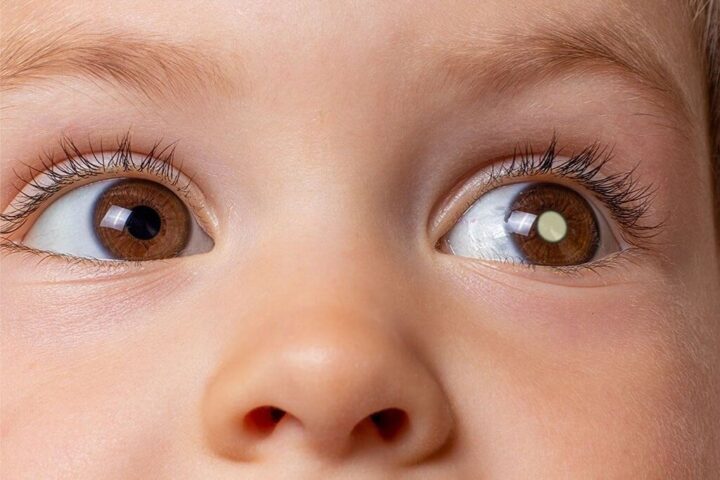


Tear Congestion in Children
Tear duct obstruction is one of the common problems in babies. It is seen in 6% to 20% of newborn babies. Although it usually resolves spontaneously, tear duct obstruction persists in some babies. Tears secreted from the tear glands serve to keep the eye constantly moist. The tears that have done their job are pumped towards the nose through two holes located on the upper and lower eyelids near the nose, right next to the eye spring. If you look carefully in the mirror, you can see pinhole-sized holes yourself.
Tears passing through these holes, called punctum, direct to two tear ducts on the upper and lower lids. These ducts open into the lacrimal sac.

While the baby is growing in the womb, the part of the tear duct opening to the nose is covered with a membrane. This membrane opens spontaneously close to birth. Failure to open this membrane is one of the causes of tear duct blockages. This condition can affect both eyes. As long as this membrane is blocked, tears can pass from the punctum to the ducts, but cannot pass into the nose. We can compare this to a sink with a clogged outlet. Water flows continuously from the tap, but because the sink hole is clogged, the water overflows. In a clogged tear duct, tears flow down the child’s cheek. Burring and sticking of eyelashes are also common. Just as non-flowing, stagnant water becomes dirty very quickly, when the tear duct is blocked, bacteria grow in the tears and infection occurs. Bursting indicates the presence of infection. The eye, one of our valuable organs, is constantly faced with infection.
Treatment
In the majority of babies with blocked tear ducts, this condition can improve over time. First of all, it is necessary to fight the infection. It can be expected that the tear duct will open spontaneously over time. Antibiotic drops can correct the burrs; However, antibiotics alone cannot help in opening the blocked duct. Mechanical massage with fingers should also be added to the treatment to open the canal. In this way, pus or tear-pus mixture squeezed under the finger can mechanically force and open the membrane at the end of the canal. If this happens, tears stop flowing out of the eye.
However, some babies do not open despite massage attempts, and if the infection is very severe, it would not be right to wait. If this treatment fails, it is necessary to open the canal by applying a catheter. This can be very successful in competent hands, especially as long as it does not exceed 1 year of age, and can be successful at rates of up to 95-98%. Due to the effect of the obstruction becoming chronic, the success rate of probing attempts after the age of one decreases.
The information on this page is for general information only and does not replace an examination. Please consult your ophthalmologist for diagnosis and treatment.